Learning your garden one plant at a time.
When you’re learning to garden, there is a lot of information to take in.
You might find yourself researching everything from soil pH and sunlight requirements to seed starting, companion planting, watering schedules, pests, and harvest times.
It can quickly become overwhelming.
A plant tracker template gives you a place to narrow your focus to one plant at a time.
What does this plant need?
Where does it grow best?
How long does it take to germinate?
What happened when I planted it?
Did it thrive?
What could I change?
These questions turn gardening into an active learning experience rather than simply following instructions.
The more plants you document, the more you begin to understand patterns in your own garden.
Your garden can become your classroom.
One of the things I love most about gardening is that you don’t have to know everything before you begin.
You can learn as you go.
A plant struggles, and you research why.
A seed germinates unexpectedly quickly, and you make a note of it.
A flower attracts pollinators, and you start learning more about the relationship between plants and wildlife.
A garden learning journal gives you somewhere to capture all of those discoveries.
It can include practical information such as plant identification, soil preferences, sunlight, watering, spacing, and planting dates, but it can also include your own observations and questions.
That distinction matters because gardening isn’t just about knowing information. It’s about learning how that information applies to your particular growing space.
For the new home gardener
If you’re a new home gardener, it can feel like everyone else already knows what they’re doing.
There are so many gardening books, websites, videos, and opinions that knowing where to start can sometimes be harder than actually planting something.
A beginner gardening journal can help make the process more manageable.
Instead of trying to learn everything at once, choose a few plants and begin documenting them.
Record your planting date.
Write down what the seed packet says.
Observe how the plant responds to your garden.
Research questions as they come up.
Then record what you learned.
Your garden binder pages become a reference you can return to instead of starting from scratch every season.
And eventually, you begin to develop something that no generic gardening guide can give you: knowledge of your own garden.
For the intentional mother
Gardening can also become part of how we create meaningful experiences with our children.
For the intentional mother, a garden doesn’t have to be another activity to add to an already full schedule.
It can simply be a place to be together.
A child can help plant a seed, check whether a flower has opened, look for insects, taste something growing in the garden, or notice that a plant looks different than it did yesterday.
A family garden journal can give those moments somewhere to live.
You can document what you’re growing together, write down questions your children ask, or let them draw pictures and make their own observations.
Gardening with children becomes a hands-on introduction to seasons, food, nature, patience, responsibility, and observation.
It doesn’t need to look like a formal lesson.
The garden is already teaching.
For the woman rediscovering herself
Gardening can also be deeply personal.
For the woman rediscovering herself, spending time tending plants can create a reason to step outside, slow down, and pay attention to what is happening around you.
There is something grounding about working with soil, watching a seed become a plant, or noticing the first flower of the season.
A garden observation journal can extend that experience beyond the time you spend outside.
You can record what you noticed, what surprised you, what you’re learning, and even what the garden made you think about.
This is where gardening can intersect with gardening for wellness, gardening and self care, and nature and wellness.
The purpose isn’t to turn gardening into another task you need to complete.
It’s to create a practice of paying attention.
Record the successes and the failures.
A garden record isn’t only for documenting the things that went well.
In fact, some of the most valuable information may come from the plants that didn’t thrive.
Maybe you planted something in too much shade.
Maybe the soil stayed wetter than expected.
Maybe a pest found your plants before you did.
Maybe you simply planted at the wrong time.
Write it down.
Your garden record book gives you the opportunity to look back and ask better questions next season.
Instead of viewing an unsuccessful crop as wasted effort, you can treat it as information.
What happened?
What might have caused it?
What did I learn?
What will I change?
That is how gardening knowledge develops.
Build your own plant reference guide.
After a few growing seasons, those individual pages begin to tell a bigger story.
Your plant journal printable can become a personal reference library containing the plants you’ve grown, the varieties you’ve tried, the locations where you’ve planted them, and the lessons you’ve learned.
You might eventually have detailed notes about your favorite herbs, vegetables, flowers, native plants, or perennial crops.
You’ll know which plants performed well in your space.
You’ll remember which varieties you want to grow again.
You’ll have notes about pests, harvests, soil conditions, and planting dates.
Instead of relying exclusively on generalized gardening advice, you can combine that information with your own experience.
You don’t need a perfect garden to start.
You don’t need acres of land or a large vegetable garden to keep a plant record.
You can start with a single container.
A few herbs.
A flower bed.
A small backyard garden.
Even one plant is enough.
The plant care tracker is simply a tool for helping you pay attention.
Write down what you know.
Research what you don’t.
Observe what happens.
Record what you learn.
Then use that information the next time you grow it.
Download the free Plant and Garden Record Template
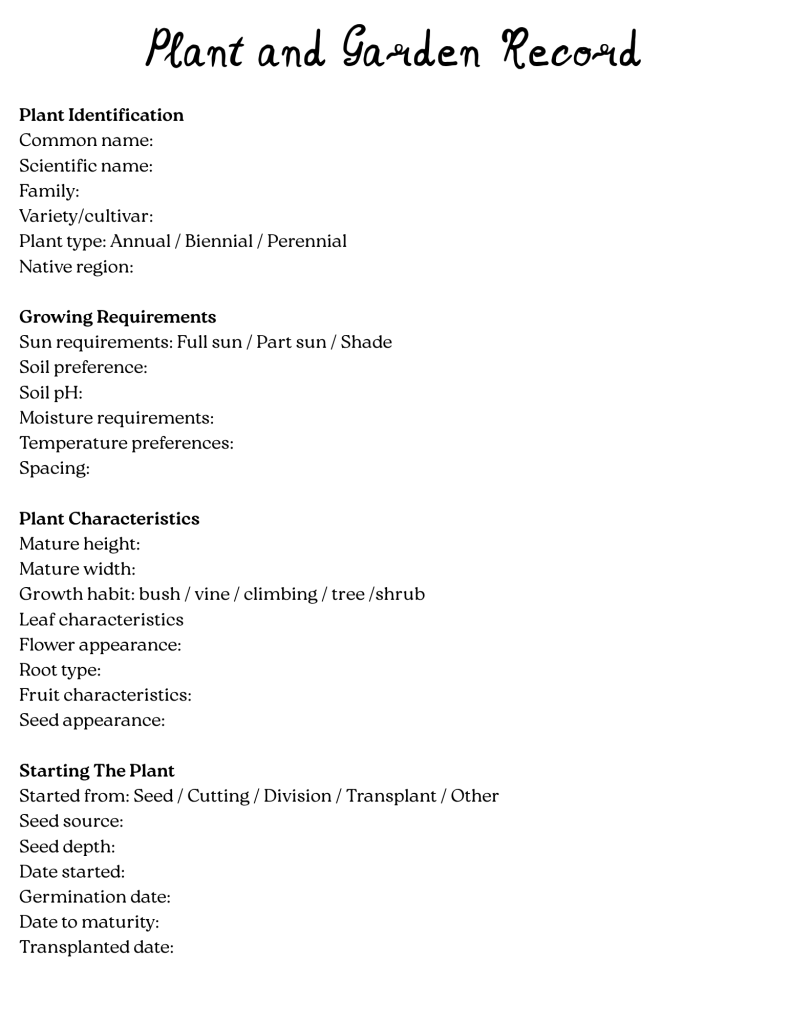
I created the Plant and Garden Record Template to make this process easier.
It’s designed to help you keep track of your plants while also giving you space to actually learn from them. You can use it as part of a printable garden binder, a gardening journal, or your own personal plant reference guide.
You’ll have space to document plant identification, growing requirements, planting dates, garden placement, care, pests, diseases, harvests, research, observations, and end-of-season reflections.
Whether you’re a new home gardener learning your first plants, an intentional mother creating a garden experience with your children, or a woman rediscovering herself through time spent in nature, the goal is the same: to create a place where you can slow down, pay attention, and learn.
Download the free Plant and Garden Record Template and start keeping a record of what your garden is teaching you.